The structural-drying decision sequence
A useful drying plan answers these six questions in order. Equipment selection comes after the incident and assembly are understood.
What water condition exists?
Source, contamination, duration and continuing intrusion can restrict whether aggressive drying or material retention is appropriate.
Which assemblies are actually wet?
Map layers and concealed pathways rather than treating the visible surface as the complete moisture boundary.
Where can moisture leave?
Finish permeability, cavity access, airflow paths and chamber leakage determine whether a proposed method can influence the wet layer.
What function is needed?
Extraction removes liquid water; air movement promotes evaporation; dehumidification removes vapor; filtration controls particulate; specialty systems target inaccessible assemblies.
Is the environment responding?
Psychrometrics and material trends show whether the drying chamber is producing useful change or merely running equipment.
What proves the endpoint?
Use repeatable material measurements and an appropriate dry standard, comparison condition or product requirement.
Go directly to the technical question
These pages now have distinct scopes. They link to one another rather than repeat the same generic restoration paragraphs.
Changing vapor load, chamber leakage, rated versus actual removal, refrigerant/desiccant selection and monitoring-based resizing.
Airflow path, pressure capability, surface contact, obstructions and pressure drying.
RH, temperature, dew point, humidity ratio and vapor-pressure relationships.
Extraction, air movement, dehumidification, HEPA filtration and specialty systems without conflating their purposes.
Material-specific endpoints, comparison readings, equilibrium and instrument context.
Defining boundaries, choosing measurement modes, tracking slow zones and closing the map with evidence.
Environmental boundaries, leakage, pressure, contamination-control objectives and safety constraints.
Depth moisture, vapor retarders, low-permeance finishes and testing appropriate to the final flooring decision.
Species, installation, subfloor, dimensional change, focused floor systems and preservation limits.
Integrity, finishes, cavity access, insulation and contamination constraints.
Fiberglass, cellulose, mineral wool, foam, facings, cavity access and adjacent structure.
Toe-kicks, composite materials, wall interfaces, countertops and concealed verification.
Apply the knowledge to an incident
The technical library explains individual questions. Incident Scope Intelligence is where those questions are combined with property type, water condition, affected assemblies, access and uncertainty.
Open Incident Scope IntelligenceFirst-Party Field Evidence
See how the investigation actually looks in the field.
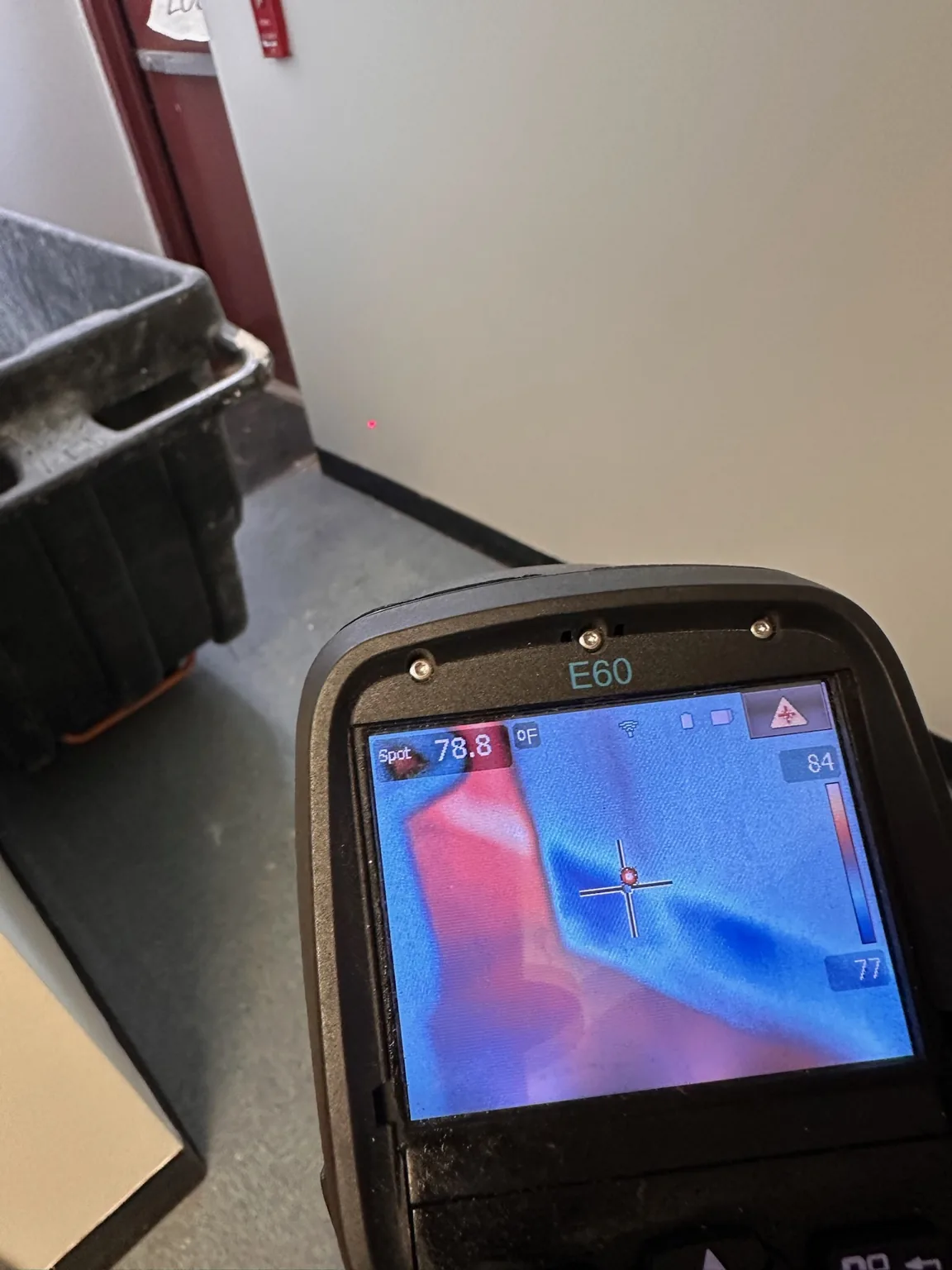
SDM Field Case 001 connects thermal screening, comparative moisture measurements, selective demolition, exposed commercial assemblies and psychrometric monitoring into one documented evidence chain.
The photographs are not used to claim more than they establish. Thermal images are described as temperature anomalies unless moisture is independently corroborated.
See It in the Field
Technical guidance connected to real mitigation work.
See an actual Corinth commercial water-loss investigation with thermal screening, moisture readings, selective demolition, exposed assemblies and drying-system documentation.